American River (2016)
Written for treble choir and violin with electronics. Composed in 2016. Commissioned and premiered by Daniel Paulson and Vox Musica with Joe Kye on violin.
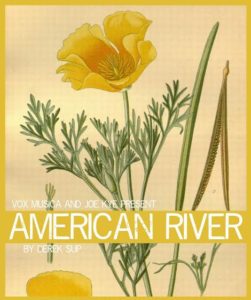
American River is part choral concert piece, part play, part staged ritual. The work is an homage to the American River, the river in Sacramento on which I spent my childhood. My house was near this river, all my friends’ houses, my elementary school, my high school, and downtown Sacramento. I was always swimming in it, kayaking on it, running and biking along it, sitting near it, fishing on it, berry and fig picking along it. I was always engaging with it one way or another.
The work follows the life of the Chinook Salmon, or Oncorhynchus tshawytscha, one of the focal points of the animal kingdom there. The salmon has a dramatic life with low chances of survival throughout its adventure to reproduce, having to travel all the way from its birthplace in the river down to the ocean, then back up again to spawn. If it is miraculously able to overcome its terribly low odds and accomplish its life mission, it will give birth near the place where it was born and immediately perish.
American River is divided into four Acts, each named after a season, and each Act begins with a Prelude. In each Prelude, a narrator sets the scene, describing what is happening at the river and the surrounding area during that season. The narrator is followed by a dialogue between to salmon sisters, an older and a younger, who are giving emotional commentary on their life paths.
The Acts are musical numbers which set the text of the animal and plant species that dominate that particular season. They move through the binomial nomenclature for each species, working down to the scientific name of the species of that Act. Spring illuminates a selection of wildflowers like the California poppy, (Eschscholzia californica), summer features figs (Ficus carica) and blackberries, autumn and winter focus on the return and spawn of the salmon (Oncorhynchus tshawytscha).
I: SPRING
In late December to February in the Sierra snowmelt waters of the American River, the salmon eggs of the Chinook Salmon, or Oncorhynchus tshawytscha, lay buried in redds–the nests that salmon create in the gravel riverbed. In eight to twelve weeks, at the beginning of spring, the eggs will hatch into alevins, and they will absorb their yolk sacs, continuing to live in the safety of the redds. Along the bluffs and throughout the surrounding land bloom a myriad of flowers, including the bright oranges of California Poppy (Eschscholzia californica), as well as purple stalks of Lupine (Lupinus perennis), and western goldenrod (Euthamia occidentalis). By this time, the parents of these salmon eggs either will have died or are miraculously making the return journey back to the Pacific Ocean, leaving their hatchlings to fend for themselves.
Plantae
Angiosperme
Eudicotidae
Ranunculales
Papaveraceae
Eschscholzia
Eschscholzia Californica
II. SUMMER
The salmon develop into fry during the summer months, and feed on small organisms in the water. They will remain in the freshwater of the American River as fry anywhere from a year to three years before leaving their redds and swimming downstream. Feeding on aquatic insects, amphipods, and other crustaceans, they develop into smolts, and make their way into the estuaries and eventually into the ocean. In the ocean, they will travel thousands of miles, and sometimes as far as the Bering sea and up to Alaska. This lifecycle that requires them to transition from freshwater to saltwater and back again makes them anadromous, meaning they migrate to freshwater to spawn.
At the American River, the weather can be exceedingly hot, often reaching above 100 degrees F, and the water hovering around 60 degrees F. Fig trees and blackberry bushes fruit in abundance on the perimeter of the river.
Kingdom: Plantae
Clade: Angiospermae
Clade: Eudicotidae
Clade: Rosids
Order: Rosales
Genus: Moraceae
Family: Ficus
Species: Ficus carica
ACT III: AUTUMN
Once they have fully developed in the ocean and are ready for the journey home, the salmon begin to swim back to the rivers in which they were conceived. They will need immense strength for the journey that awaits them back up the river. They swim under the Golden Gate bridge and up through the San Pablo Bay. navigating themselves by detecting and responding to the earth’s magnetic fields, to which they are ultra-sensitive.
They find the mouth to the Sacramento River and swim hundreds of miles upstream to where it forks into the American, eating nothing during their travels, functioning entirely on stored fat. When they arrive near to their original birthplaces, the salmon find a suitable patch of loose gravel on the riverbed. The female floats just above the floor, and the male floats above her. Several males will approach the male to challenge him for his position with that female, and the male will chase these adversaries away.
The female lies on her side and with intense gyrations of her body uses her tail as a shovel to create a depression in the riverbed. When the hole is deep enough, she will deposit her eggs, and the male will simultaneously release his sperm, fertilizing the eggs. This is an act of semelparity, which is a breeding technique in which the organism dies directly after a single climactic reproductive episode.
Kingdom: Animalia
Phylum: Chordata
Class: Actinopterygii
Order: Salmoniformes
Family: Salmonidae
Genus: Oncorhynchus
Species: Oncorhynchus tschawytscha
INTERLUDE: CATHARTES AURA
After the salmon spawn and their tired bodies begin to wind down in preparation for death, scavengers gather to feast. Turkey vultures, or Cathartes aura, fly in circles above carcasses that have washed up onto the riverbanks, usually in groups. Vultures feed on almost exclusively carrion, and can ingest the bacteria in rotting flesh without any ill-effects. The nomenclature for this large fowl, with its notorious bald red head and hunching black body, is rich with symbolism. The common name, “vulture” comes from the Latin word vulturus, which means “tearer,” in reference to their eating habits. The genus, Cathartes, translates to “purifier,” in Greek; and Aura, the species name, is Latin for “breeze, air, or wind.”
IV. WINTER
After some days of defending the redd, the mother dies. The father will go off to seek more potential mates and then die. Very rarely do salmon have the energy to make the return journey to the ocean. Their bodies will decompose on the riverbed or wash up on the banks to be consumed by scavengers. In a couple weeks, their eggs will hatch into alevins and the life cycle will start over again.
Species: Oncorhynchus tschawytscha
Family: Salmonidae
Order: Salmoniformes
Class: Actinopterygii
Phylum: Chordata
Kingdom: Animalia
Domain: Eukaryota
Life (?): Vita
Breath (?): Anima
Wind (?): Aura
Amen: Amen